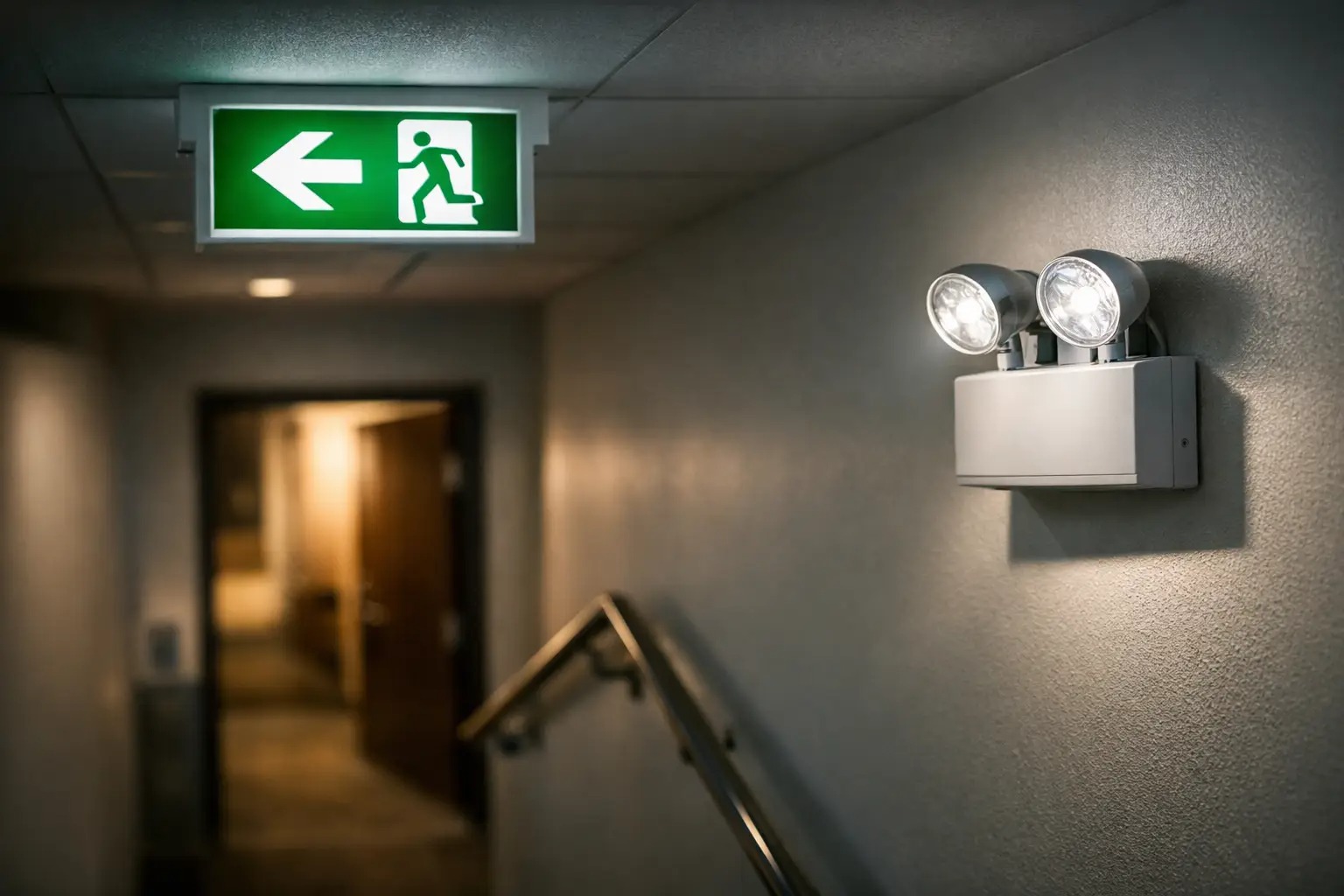
When the mains power fails, a building changes instantly. Corridors become unfamiliar, stairways turn into potential hazards, and a straightforward exit can quickly become confusing. That's why emergency lighting is such an important part of building safety for landlords, business owners, managing agents and property managers throughout North West London.
Emergency lighting is not designed to improve appearance or provide convenience. Its purpose is simple but critical – helping people see clearly and leave a building safely when normal lighting fails. Whether you manage a block of flats, HMO, office, shop or commercial premises, having the right emergency lighting system can help protect occupants and support compliance with current safety requirements.
What Is Emergency Lighting?
Emergency lighting provides illumination when the normal mains-powered lighting supply is lost. This could be due to an electrical fault, power cut, fire-related incident or damage to an electrical circuit.
Emergency light fittings contain battery backup systems that automatically operate when the mains supply fails. These fittings remain illuminated long enough to help occupants identify escape routes and leave the building safely.
Emergency lighting commonly covers:
- Escape routes
- Staircases
- Corridors
- Changes in floor level
- Final exits
- Fire alarm call points
- Firefighting equipment locations
- Emergency exit signage
Unlike decorative lighting or security lighting, emergency lighting has a dedicated life-safety function and must be properly designed, installed, tested and maintained.
Types of Emergency Lighting
Not every property requires the same emergency lighting arrangement. The correct system depends on the building's size, layout, occupancy levels and fire risk assessment.
Maintained Emergency Lighting
Maintained fittings operate continuously during normal use and remain illuminated during a power failure. These are often used for emergency exit signs and areas where constant visibility is required.
Non-Maintained Emergency Lighting
Non-maintained fittings remain off during normal operation and automatically illuminate when the mains power fails. These are commonly found in offices, communal areas, warehouses and commercial premises.
Self-Contained Emergency Lighting
Each fitting contains its own battery backup. These systems are often suitable for small and medium-sized buildings due to their simplicity and flexibility.
Central Battery Systems
A central battery unit supplies multiple emergency fittings throughout a building. These systems are often installed in larger commercial properties where centralised maintenance and monitoring are beneficial.
A small residential block, for example, will usually require a different solution from a restaurant, office building or large HMO. This is why professional assessment is essential before installation.
Where Is Emergency Lighting Required?
Emergency lighting is commonly installed in:
- Commercial premises
- Offices
- Shops and retail units
- Restaurants and hospitality venues
- HMOs
- Apartment blocks
- Communal corridors and staircases
- Schools and educational facilities
- Healthcare buildings
Particular attention is usually given to escape routes, stairwells, final exits, windowless rooms and areas where occupants may need to navigate safely during a power failure.
For landlords and managing agents, communal areas are often where emergency lighting plays a vital role. Shared corridors, staircases and entrance halls may all require adequate illumination to support safe evacuation.
Why Correct Emergency Lighting Design Matters
Installing additional fittings does not automatically create a safer environment.
Effective emergency lighting relies on proper positioning, correct light levels and suitable coverage. Poorly placed fittings can leave key areas in shadow, making escape routes difficult to follow during an emergency.
A professional emergency lighting assessment considers:
- Building layout
- Escape routes
- Stair locations
- Door positions
- Potential obstacles
- Occupancy levels
- Day-to-day use of the premises
The objective is simple: ensure people can identify and follow a safe route out of the building if normal lighting fails.
Emergency Lighting Compliance and Safety
Emergency lighting should never be treated as an afterthought. Proper installation, testing and maintenance are important aspects of building safety management.
For landlords, businesses and duty holders, emergency lighting can form part of wider fire safety responsibilities. If a system fails during an emergency, the consequences can be significant for both occupant safety and property management obligations.
Requirements vary depending on the building type and how it is used. A qualified electrician can assess the premises and provide practical advice based on the specific risks and layout of the property.
Emergency Lighting Testing and Maintenance
Installing emergency lighting is only part of the process. Regular testing and maintenance are essential to ensure the system will perform correctly when needed.
Because emergency lighting relies on battery backup, components naturally deteriorate over time. A fitting may appear normal during everyday use but fail to operate for the required duration during a power outage.
Routine maintenance helps identify:
- Battery failures
- Faulty fittings
- Damaged components
- Reduced backup duration
- Coverage issues caused by building alterations
If layouts have changed through refurbishment, new partitions or room reconfigurations, the emergency lighting design may also need reviewing.
Regular testing helps ensure the system remains reliable and suitable for the building's current use.
Common Emergency Lighting Mistakes
Many property owners assume emergency lighting is only necessary in large commercial buildings. In reality, smaller premises can present significant risks if escape routes become dark during a power failure.
Other common mistakes include:
- Failing to carry out routine testing
- Ignoring fault indicators
- Not updating systems after refurbishments
- Choosing equipment based solely on price
- Assuming existing installations remain suitable indefinitely
A properly maintained emergency lighting system should be viewed as a long-term safety investment rather than a one-off installation.
Choosing an Emergency Lighting Electrician in North West London
Emergency lighting should be approached as a specialist safety service rather than a simple fitting replacement.
A competent electrician will assess the property, explain requirements clearly and provide recommendations based on the building's specific needs.
Whether you are a landlord, managing agent, business owner or property manager, you need practical advice, quality workmanship and a system that performs when it matters most.
At Lighthouse Engineering Ltd, we provide emergency lighting installation, testing, fault finding and maintenance services across North West London, including Dollis Hill, Cricklewood, Wembley, Hendon, Willesden, Kilburn and surrounding areas.
When Should You Arrange an Emergency Lighting Inspection?
It may be time to arrange an assessment if:
- You are unsure when the system was last tested
- You have taken over responsibility for a building
- A recent refurbishment has altered escape routes
- Fault indicators are showing on fittings
- You are uncertain whether emergency lighting is required
- Existing equipment appears outdated
Emergency lighting often goes unnoticed because it sits quietly in the background. That is exactly how it should be – ready, reliable and prepared to protect occupants whenever normal lighting fails.
If you need emergency lighting installation, testing or maintenance in North West London, Lighthouse Engineering Ltd can provide clear advice and professional electrical services to help keep your property safe. Get in touch today!